
Poople answer for November 12, 2026: LAZY to POOP
Confirm that your puzzle starts at LAZY. If you are playing a different day, use the current answer page to check its status.
Game-day window: until . The title identifies that puzzle edition. The first-published timestamp records when this article actually became available, so its UTC calendar date can differ from the game date.
What to notice in this puzzle: LAZY begins with no letters in their target positions. The four mismatches set a lower bound, but the checked minimum is six moves. Two opening changes make useful connections before the first target-position match appears; the explanation shows how that progress differs from merely counting matching letters.
Reveal the 6-move solution Full spoiler
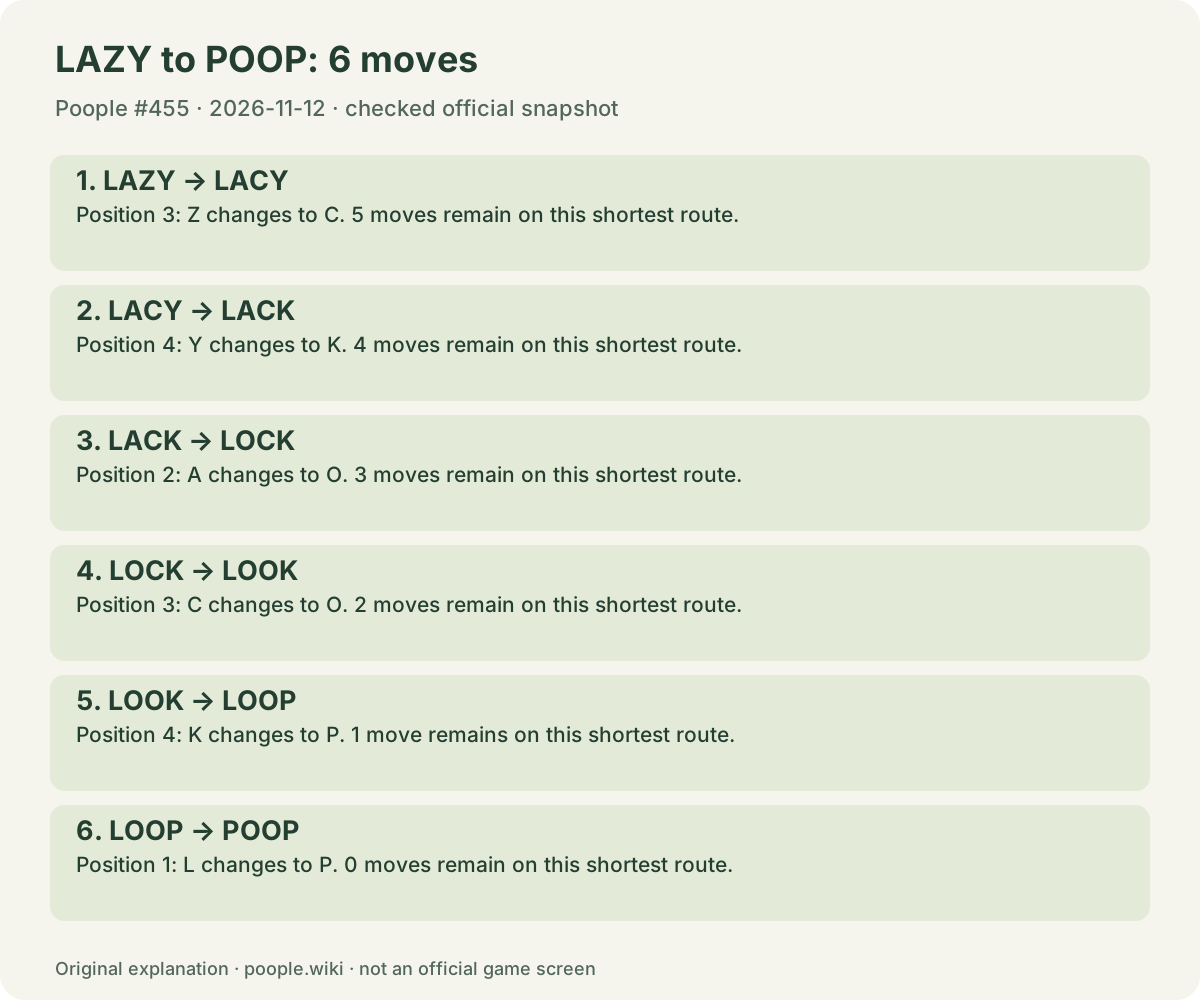
LAZY → LACY → LACK → LOCK → LOOK → LOOP → POOP
7 words. 6 changes. A shortest route in the checked official word list; equally short alternatives may exist.
LAZY → LACY— position 3, Z to C. Replace the third letter only. L, A and Y stay in their original positions; C provides the next connection in this checked route.LACY → LACK— position 4, Y to K. Replace the final Y with K. The opening LAC stays fixed, so this is a single change despite the different ending.LACK → LOCK— position 2, A to O. Keep L and the final CK. The second position now matches the target for the first time on this route.LOCK → LOOK— position 3, C to O. The temporary C becomes the second O. Keep the first L, existing O and final K unchanged.LOOK → LOOP— position 4, K to P. Change only K to P. The final three letters now match POOP, leaving the first position to finish.LOOP → POOP— position 1, L to P. Replace the initial L with P. OOP stays fixed, completing move six rather than a seventh move for the starting word.
Why this route works
Poople #455, for November 12, 2026, begins with LAZY. The checked answer shown here is LAZY → LACY → LACK → LOCK → LOOK → LOOP → POOP: seven words connected by six single-letter changes. Its distinctive feature is the opening pair of moves. Neither puts a letter into its final target position, yet both bring the target closer in the accepted-word network. The route first uses C and K as temporary connecting letters, builds the two middle O letters, and leaves the initial L until the very last move. Follow the position checks below to see exactly where those six changes go.
Count the four mismatches without mistaking them for a solution
Align LAZY above POOP and read the four columns. L differs from P, A from O, Z from O, and Y from P. Every position therefore needs at least one replacement. Four is a lower bound on the number of moves: a change can fix at most one of these columns. However, choosing four letters to replace is only part of a word ladder. Each intermediate result also has to be an accepted word.
A four-move answer would have to change each position exactly once, directly to its final letter. That observation narrows what such an answer could look like, but it does not by itself test every possible order. We do not claim that a quick visual inspection rules out all four-move or five-move routes. The six-move minimum comes from the independent graph search described below, supported by the official distance table.
For this displayed answer, count edits by column instead: position one changes once, position two once, position three twice and position four twice. Their total is six. The additional changes are not moves that could simply be deleted from the printed solution. They let the route pass through accepted intermediate words before the last two columns receive their target letters.
The opening changes Z and Y before adding any target letters
LAZY to LACY is the third-position substitution Z to C. It leaves the opening LA and final Y intact. The following move changes that Y to K, producing LACK while preserving LAC. These are two distinct operations. Jumping directly from LAZY to LACK would replace both Z and Y, which breaks the one-position rule even though the destination appears later in the verified chain.
The starting word, LACY and LACK each have zero letters matching POOP in the same position. That makes this opening a useful example of progress that a simple match counter cannot show. Their checked remaining distances are six, five and four respectively. You have moved two steps closer to completion even though none of the four columns is finished yet.
C and K do different jobs in different columns. C occupies the third position until it becomes O; K occupies the fourth until it becomes P. Neither is moved to another position, and neither remains in the completed target. When reviewing an attempt, track these columns independently instead of treating CK as a two-letter block that must be replaced in one action.
Finish the middle, the right edge and finally the left edge
At LACK, change A to O in the second position to make LOCK. This is the first target-position match in the displayed answer. Next, replace the third-position C with O to make LOOK. The existing O stays where it is. That creates the central OO pair through two separate submissions, with the outer L and K held fixed during both moves.
LOOK becomes LOOP when the final K changes to P. At that point OOP already agrees with the last three positions of POOP. Only the first L remains to be replaced. The final move, LOOP to POOP, changes that L to P and keeps OOP intact. Retaining L until the end is a feature of this particular construction, not a general instruction to finish the leftmost position last.
Read the middle and final words in adjacent pairs if a step is rejected. LOCK cannot jump directly to LOOP because both C and K would change. LOOK cannot jump directly to POOP because both the first L and last K differ. These checks concern spellings already present in the verified route. They do not introduce an untested alternative or assume that another dictionary accepts a missing intermediate word.
Use the end of the ladder to check your place
The final three words provide an easy backward check. POOP is one replacement from LOOP, and LOOP is one replacement from LOOK. Looking backward here is a way to inspect the same accepted connections; it does not require a different word list or establish a new solution. The direction of reading changes, but the differing position in each neighboring pair stays the same.
This also helps if your current attempt has already joined the displayed route. From LOOK the shown finish takes two moves; from LOCK it takes three. Those are remaining distances, not total scores. For example, if an attempt reaches LOCK after spending five moves, following the three-move suffix produces eight moves overall. This is an illustrative count, not a claim about any player’s recorded attempt.
If your current word is not on this route, do not assume you can enter at whichever later word looks useful. Compare all four positions before proposing the connection, and check acceptance in the game. The article only verifies the listed edges. Returning to a familiar word or skipping a row does not erase moves already made, and seven words on the diagram still represent only six transitions.
What establishes six moves for this official puzzle
The full chain establishes that six moves are possible. To establish the minimum, the verification also ran breadth-first search across the 2,398 accepted four-letter entries in the observed official source. That search explores connections in increasing numbers of moves and reaches LAZY at distance six from POOP. The official distance table independently reports six as well. Their agreement supports the stated minimum within that particular source snapshot.
Along the answer, graph distances decrease as 6, 5, 4, 3, 2, 1, 0. Positional mismatches decrease as 4, 4, 4, 3, 2, 1, 0. The initial gap disappears at LACK: its remaining four-step finish changes each still-wrong column once. This explains the role of the opening setup without claiming it is the only shortest answer, rating player difficulty, or inventing completion statistics.
This record uses the official source observed at 09:16:44 UTC on November 12. Its game-day window starts at 08:00 UTC on November 12 and ends at the next 08:00 UTC boundary. Match LAZY and puzzle #455 before applying it. The check concerns public source data and an independent calculation; it is not a replay through the official interface. Our separate ENABLE-based solver may use different connections, so a route from that tool needs its own acceptance check.
Watch the route explained
Remaining moves on this checked route
| Word | Moves to POOP |
|---|---|
| LAZY | 6 |
| LACY | 5 |
| LACK | 4 |
| LOCK | 3 |
| LOOK | 2 |
| LOOP | 1 |
| POOP | 0 |
Each suffix of a shortest route must also be shortest: a shorter suffix would give a shorter complete route. These values describe remaining changes, not the moves already used on your board.
What this Poople answer teaches
A useful move can leave every target position unmatched. Follow accepted connections as well as visible similarity when assessing this puzzle.
The verified route edits two positions twice and two positions once. Counting those replacements explains its six moves without treating the starting word as a move.
How this Poople answer was verified
Source identity and route checks
We checked the public official game implementation on . Its accepted-word distance table and an independent breadth-first search both give a minimum of 6 moves for LAZY. This answer was checked against its source and algorithm; we did not replay it through the official game interface.
The source snapshot identifies this as puzzle #455. A later change to the original dictionary could alter which words are accepted. The independent solver uses a different word list, so its shortest distance can differ.
- Official Poople game — checked 2026-11-12.
- Official public game implementation — checked 2026-11-12.
Corrections and verification limits
Corrections are recorded here when a published result changes. No corrections have been recorded for this revision. See our editorial policy or report a rejected step. The verification timestamp is the source observation, not a claim that a human played through the original interface.
More Poople help and recorded puzzles
For a smaller nudge use today's Poople hints. For another starting word use the Poople solver with its independent-dictionary notice, or review how to count one-letter moves.
Browse all verified past Poople answers by game date, starting word or puzzle number.
- November 11, 2026 (#454): PANE — adjacent published record, not necessarily the previous or next game day.