
Poople answer for November 11, 2026: PANE to POOP
Confirm that your puzzle starts at PANE. If you are playing a different day, use the current answer page to check its status.
Game-day window: until . The title identifies that puzzle edition. The first-published timestamp records when this article actually became available, so its UTC calendar date can differ from the game date.
What to notice in this puzzle: PANE already has the correct first letter, but three mismatched positions do not imply a three-move solution. The checked minimum is five. This route uses two temporary letters before completing the middle pair and the final position; the analysis distinguishes visible letter matches from actual distance through accepted words.
Reveal the 5-move solution Full spoiler
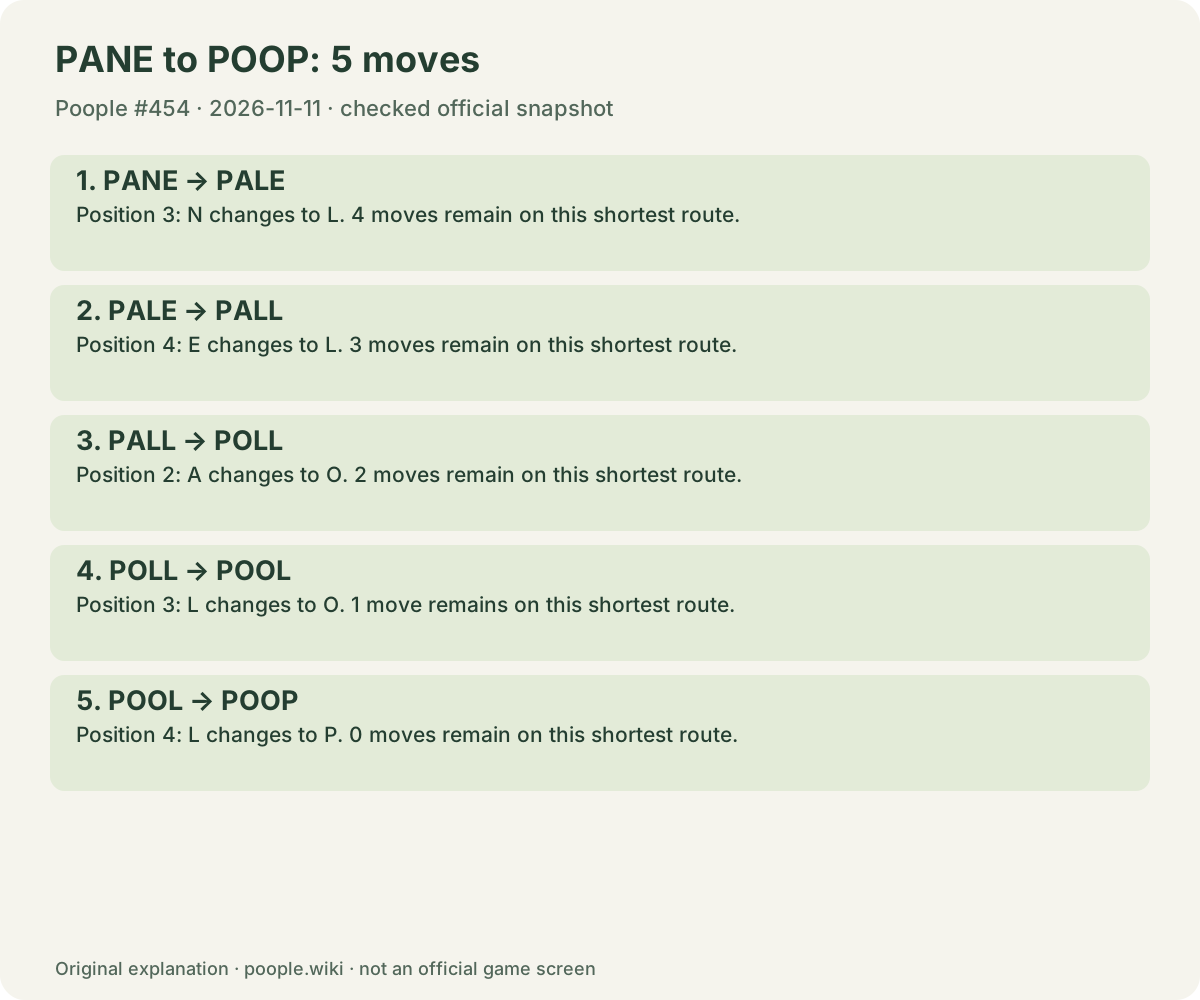
PANE → PALE → PALL → POLL → POOL → POOP
6 words. 5 changes. A shortest route in the checked official word list; equally short alternatives may exist.
PANE → PALE— position 3, N to L. Keep P, A and E in place. The new L is temporary: it opens the next checked connection rather than immediately matching the target O.PALE → PALL— position 4, E to L. Keep P, A and the third-position L. Changing only the final E creates the double-L ending used by this route.PALL → POLL— position 2, A to O. Keep the first P and the final LL. This replacement supplies the first of the two middle O letters.POLL → POOL— position 3, L to O. Keep P, the second-position O and the final L. This is one replacement, not an exchange of positions.POOL → POOP— position 4, L to P. Keep POO unchanged. Replace the final L with P to complete the fifth move.
Why this route works
The Poople answer for November 11, 2026, puzzle #454, starts with PANE and reaches POOP in five moves. One checked shortest route is PANE → PALE → PALL → POLL → POOL → POOP. That is six words, with the starting word counted as step zero. All six entries belong to the accepted-word set in the freshly checked official runtime. An independent breadth-first search finds the same five-move minimum as the official distance table. The explanation below follows the actual changed positions and shows why the two early setup moves count as progress even though the words do not yet look more like the target. This is a source and algorithm check, not a recording of an official-game playthrough.
Read PANE by position before choosing a move
Write the opening and target as four aligned positions: P A N E above P O O P. The first P is already correct. The other three positions differ, so any complete route needs at least three replacements. This simple count is useful for checking an impossible claim, such as reaching POOP in two moves. It does not establish that a three-move route exists: every intermediate spelling must also be accepted.
The displayed answer retains the initial P from beginning to end. That is a property of this verified route, not a rule that every valid or shortest answer must obey. If you are exploring independently, do not reject a legal branch solely because it changes a correct letter. The relevant question is whether accepted connections lead onward. Here we can show a five-step construction without changing that first position.
The change-position sequence is 3, 4, 2, 3, 4. Positions three and four are each edited twice, while position two is edited once. This accounts for all five moves and explains the difference from the three-position lower bound. There are two additional replacements in this construction because temporary letters occupy positions that must later change again. No insertion, deletion or letter rearrangement is involved.
Why the two temporary L letters help
PANE becomes PALE by replacing N with L in the third position. PALE still matches POOP only at the first position, just as PANE did. Nevertheless, its independently checked distance to the target is four rather than five. A move can therefore reduce the number of changes still needed while leaving the visible match count unchanged. The L is useful because of the accepted neighbors it connects, not because L occurs in the final target.
Next, PALE becomes PALL by replacing the final E with L. The two L letters now occupy different positions; neither can be moved around as a tile. PALL still has only the initial P in its final place, but its remaining distance is three. These first two transitions have taken the route from distance five to distance three without improving its count of correct target positions.
This is the point where the route stops needing temporary replacements. From PALL, its remaining three mismatches can each be corrected once, through the checked words shown below. Looking at that short finish is more informative than treating PALL as a setback because it contains no O. Its value lies in an accepted continuation that fixes the second position, then the third, then the fourth.
Build the OO middle, then finish the last letter
PALL to POLL changes A to O in position two. The other three letters stay fixed. POLL to POOL then changes the third-position L to O, preserving the O already in position two. Reading those two rows quickly can make the move resemble a shuffle of O and L, but that is not what happens: the second position remains O, the third changes, and the final position remains L.
POOL now differs from POOP only in the last position. Replacing that L with P completes the ladder. The first P was retained throughout, so the finished word has a P at each end even though only the final one needed to be introduced. Count the five transitions, not the six displayed words. The starting PANE is a board state, not a submitted change.
Several tempting shortcuts in the printed chain fail the one-position rule. PALE directly to POLL changes positions two and four. PALL directly to POOL changes positions two and three. POLL directly to POOP changes positions three and four. These are structural comparisons of known route words, not claims about additional dictionary entries. Keep the intervening word in each case rather than combining two replacements into one move.
Check the minimum, not just the completed chain
A legal five-move chain proves that five moves are sufficient. It does not, on its own, prove that four or three are impossible. For the minimum claim we used a separate breadth-first search over the 2,398 accepted four-letter entries in the observed official snapshot. Starting from POOP, the search explores all words one move away, then two moves away, and so on. PANE is first reached at distance five.
The checked remaining distances along this particular chain are five, four, three, two, one and zero. Each displayed transition reduces that distance by exactly one. In contrast, the number of positions different from POOP is three, three, three, two, one and zero. Comparing these two sequences explains the opening: positional similarity stays flat for two moves while genuine progress through the accepted-word graph continues.
The official distance table also gives five for PANE, matching the independent result. That agreement is a cross-check rather than a replacement for the search. It does not establish that the shown route is unique, that everyone will find it equally difficult, or that a later dictionary revision must preserve its length. No player win rate, average completion time or personal streak is inferred from these word distances.
Use this record with the right puzzle and word list
Before following the answer, compare your opening word and puzzle identity with PANE and #454. This permanent record belongs to the November 11 game day. A later visit does not turn it into a newer daily answer. If your board starts elsewhere, use the current answer status or the archive to locate a matching record instead of forcing this sequence onto a different opening.
If you have already taken another branch, first compare your current four letters with the next proposed word. A word appearing in this solution is not automatically a legal next move from your board. For example, the checked transition into POOL starts at POLL. Your own current state still needs the same one-position test, followed by acceptance in the game you are actually using.
Our independent solver and unlimited practice use an ENABLE-based list, which is different from this official evidence set. A route produced there should be read within that tool’s stated vocabulary. If the official game rejects a displayed move, retain the preceding word, proposed word and game date when reporting it. Those details help distinguish an input mistake from a source change without assuming either explanation in advance.
Watch the route explained
Remaining moves on this checked route
| Word | Moves to POOP |
|---|---|
| PANE | 5 |
| PALE | 4 |
| PALL | 3 |
| POLL | 2 |
| POOL | 1 |
| POOP | 0 |
Each suffix of a shortest route must also be shortest: a shorter suffix would give a shorter complete route. These values describe remaining changes, not the moves already used on your board.
What this Poople answer teaches
The opening already matches the target at position one. Three mismatches give a lower bound, while the checked accepted-word graph establishes a five-move minimum.
Two setup moves can reduce the remaining distance without adding a target-position match. The changed-position sequence makes that progress visible without claiming this route is unique.
How this Poople answer was verified
Source identity and route checks
We checked the public official game implementation on . Its accepted-word distance table and an independent breadth-first search both give a minimum of 5 moves for PANE. This answer was checked against its source and algorithm; we did not replay it through the official game interface.
The source snapshot identifies this as puzzle #454. A later change to the original dictionary could alter which words are accepted. The independent solver uses a different word list, so its shortest distance can differ.
- Official Poople game — checked 2026-11-12.
- Official public game implementation — checked 2026-11-12.
Corrections and verification limits
Corrections are recorded here when a published result changes. No corrections have been recorded for this revision. See our editorial policy or report a rejected step. The verification timestamp is the source observation, not a claim that a human played through the original interface.
More Poople help and recorded puzzles
For a smaller nudge use today's Poople hints. For another starting word use the Poople solver with its independent-dictionary notice, or review how to count one-letter moves.
Browse all verified past Poople answers by game date, starting word or puzzle number.
- November 8, 2026 (#451): REPO — adjacent published record, not necessarily the previous or next game day.