
Compare Games Like Poople
Poople asks you to build a four-letter route to POOP, replacing one letter at each step. The alternatives below share parts of that appeal, but they do not all use word ladders. A game about finding a hidden word can feel very different from one where the destination is visible.
Read the rules at a glance
All five have official browser destinations. The table describes the named standard game, not every variant. Rules and access information were checked on ; an unconfirmed item is left unconfirmed.
The filter changes this table only. Your choice is not saved or added to the URL.
Showing all 5 games.
| Game and type | Goal and action | Puzzle options | Platform | Cost and access |
|---|---|---|---|---|
| Weaver official site Word ladder | Connect the supplied words; replace one letter per accepted step. | Daily puzzle; past-puzzle feature. | Browser | Current price and login requirements not confirmed. |
| Wordle official site Word guessing | Find a hidden five-letter word in six guesses. | Daily puzzle; subscriber archive. | Browser; NYT apps | Daily game needs no subscription; archive requires eligible access. |
| Connections official site Word grouping | Sort sixteen items into four related groups. | Daily puzzle; subscriber archive. | Browser; NYT apps | Daily game free without registration; archive requires eligible access. |
| Contexto official site Contextual similarity | Guess words; use their similarity ranks to find number one. | Daily game; previous-games option listed. | Browser | Paid ad-removal option documented; other access conditions not confirmed. |
| Waffle official site Letter swapping | Rearrange letters into crossing words within fifteen swaps. | Daily Waffle; archive. | Browser | Supporter benefits and some ad-gated access documented; see mode details. |
Choose daily puzzles or more rounds
A daily puzzle gives you a shared challenge to discuss. An archive gives you older challenges; it is not necessarily an unlimited random mode. Check the selected game's access terms before planning a long session. Our independent word ladder practice is another option when you want more routes rather than another daily answer.
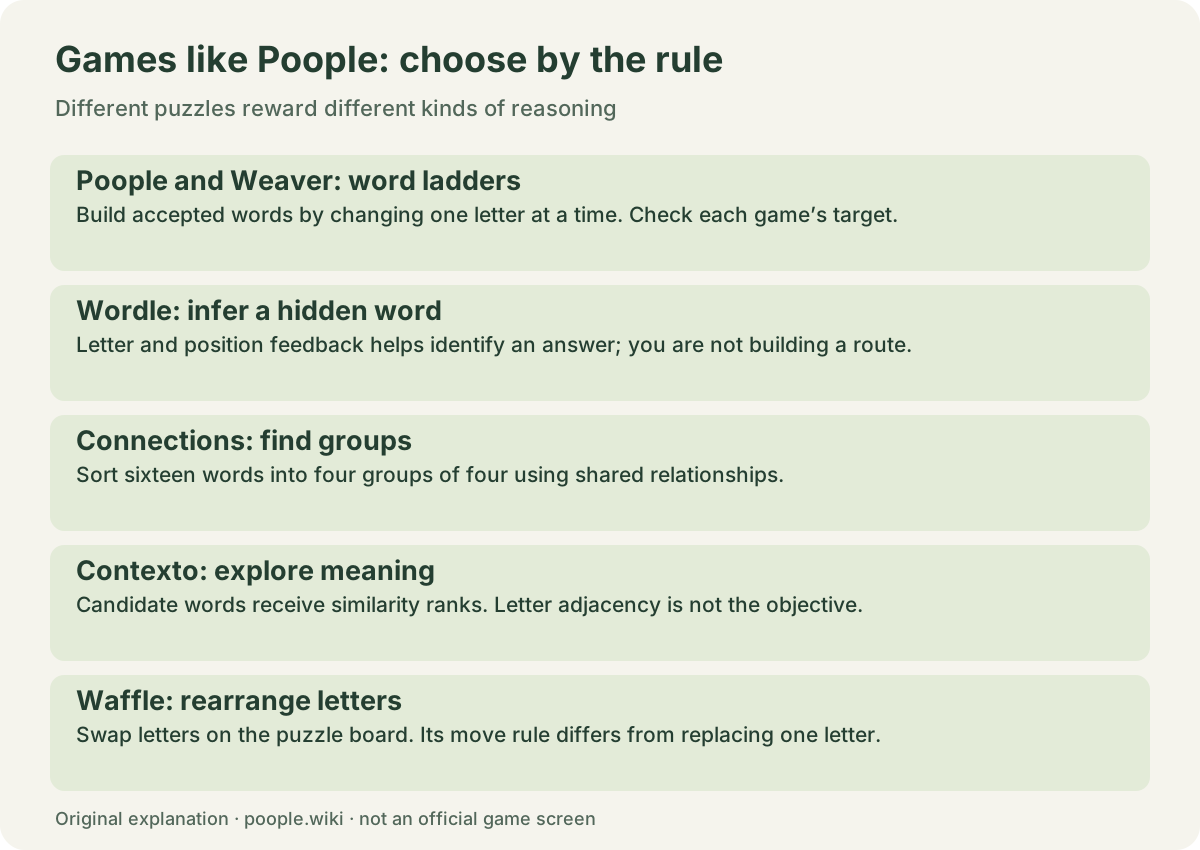
Watch the rules compared
Games That Use Word Ladders
Weaver: change one letter per move
Weaver is the closest match here because each accepted step changes one letter while keeping the word length fixed. Its own instructions and move validation require a word from its dictionary. That makes planning connections relevant in much the same way as in Poople. The official Weaver game supplies the start and target rather than asking you to discover a concealed answer.
Choose it if the satisfying moment for you is finding a bridge between two awkward words. A useful habit is to consider several neighbors before committing to a branch. Do not assume that a word accepted in Poople, Weaver or our practice tool will be accepted in the others: each game's vocabulary defines its available routes.
Compare starting and target words
Poople's fixed destination lets you become familiar with ways into POOP. A ladder with a different destination asks you to inspect the other end afresh. Neither format makes a route good simply because more letters match the target. Try an example such as COLD to CORD: only position three changes. That illustrates the operation, not a checked answer for today's Weaver.
If you want to learn the basic operation first, learn Poople's rules. If you want the entire route calculated, explore a route with our solver. The solver reveals answers and uses an independent dictionary, so leave it closed when you want to preserve your own search.
Daily Word Games with Different Rules
Wordle: guessing letters and positions
Wordle replaces route building with deduction. Submit a five-letter guess and use the feedback to narrow the possible answer; the standard daily game allows six attempts. Our recommendation is to choose it when you enjoy eliminating possibilities. A new guess need not be a one-letter neighbor of the last. See the official Wordle rules and access notes.
Connections: grouping words by a shared idea
Connections presents sixteen items to sort into four groups. Its editors deliberately include possible overlaps, so noticing a plausible relationship is only part of the task. Consider whether the remaining items can also form coherent groups before committing. This is a useful change of pace if you like interpreting language more than changing spellings. The official Connections guide explains the grouping format.
Contexto: following contextual similarity
Contexto accepts repeated guesses without a fixed guess limit. Its instructions describe an algorithm that orders words using how they occur in text; the target occupies rank one. This is not a spelling-distance ladder, and a closely related idea need not have similar letters. Try it if testing a new subject area sounds more appealing than comparing letter positions. Its official instructions also explain why association is not simply a list of synonyms.
Waffle: rearranging a shared letter board
Waffle asks you to swap existing letters into horizontal and vertical words. The standard puzzle sets a fifteen-swap limit, with position feedback helping you judge the arrangement. Unlike a ladder, you are managing several intersecting words at once. Before moving a letter, consider both the word it leaves and the word it joins. Use the official Waffle help for its corner and repeated-letter cases; Poople's one-change rule does not apply.
Poople Versus Wordle
Building a route versus guessing a word
In Poople you know where you want to finish. The uncertainty is which accepted intermediate words connect your position to that destination. In Wordle you are trying to identify the destination itself. A productive Poople move opens connections; a productive Wordle guess gives information about a hidden answer. That distinction matters more than the shared appearance of letter boxes.
It also changes what help is useful. A Poople hint might suggest a direction or next step. A Wordle hint might narrow the answer's letters or meaning. Do not transfer scores between the games: six guesses and six ladder moves measure different actions. Neither number establishes that one game is harder.
Which kind of challenge fits you?
Pick Weaver when you want to keep the ladder mechanic. Pick Wordle when you want a bounded deduction problem. Pick Connections for category reasoning, Contexto for associations, or Waffle for spatial letter planning. These are choices based on their rules, not measured rankings of difficulty or completion time. Try one unfamiliar format before adding several games to your routine.
After a round, identify the part you wanted more of. Was it discovering an unfamiliar word, narrowing a set of candidates, or seeing a surprising connection? Also identify the frustrating part. If you disliked remembering which words a dictionary accepts, another ladder may preserve that frustration. If you disliked choosing an opening guess without clues, a visible board or supplied pair of words may suit you better.
You can compare two formats without comparing their scores. Give each one a fresh attempt, read its own instructions, and note whether its feedback helps you decide what to try next. Keep solution guides closed during that first attempt if discovery is the experience you want. Our solver cannot validate another publisher's guesses or reconstruct its scoring rules.
How We Check Each Game
Official sources and review dates
This comparison uses official game pages, published help and instructions delivered by the games themselves. The review date records that source check, not a claim that we completed every puzzle or tested every device. Recommendations are editorial judgments about the documented actions. Game owners can change their rules and access; follow the linked source if something differs.
Costs, access and unconfirmed details
The New York Times distinguishes its free daily puzzles from subscriber archives. Other entries document additional modes or supporter features, but this review does not establish every price or login requirement. We therefore avoid labeling all five games completely free. We also omit reset times and estimated session lengths where they are unnecessary to choosing a format.
Poople Wiki is independent of these games. Official links take you to their publishers; they do not transfer progress from our tools. Report a changed rule or access requirement with the game and source so we can correct this comparison.