
Poople answer for November 15, 2026: FURS to POOP
Confirm that your puzzle starts at FURS. If you are playing a different day, use the current answer page to check its status.
Game-day window: until . The title identifies that puzzle edition. The first-published timestamp records when this article actually became available, so its UTC calendar date can differ from the game date.
What to notice in this puzzle: Two opening replacements introduce temporary letters without gaining a target match. After that setup, four consecutive changes complete four different columns. Tracking the two repeated columns explains why the checked minimum is six rather than the four-mismatch lower bound.
Reveal the 6-move solution Full spoiler
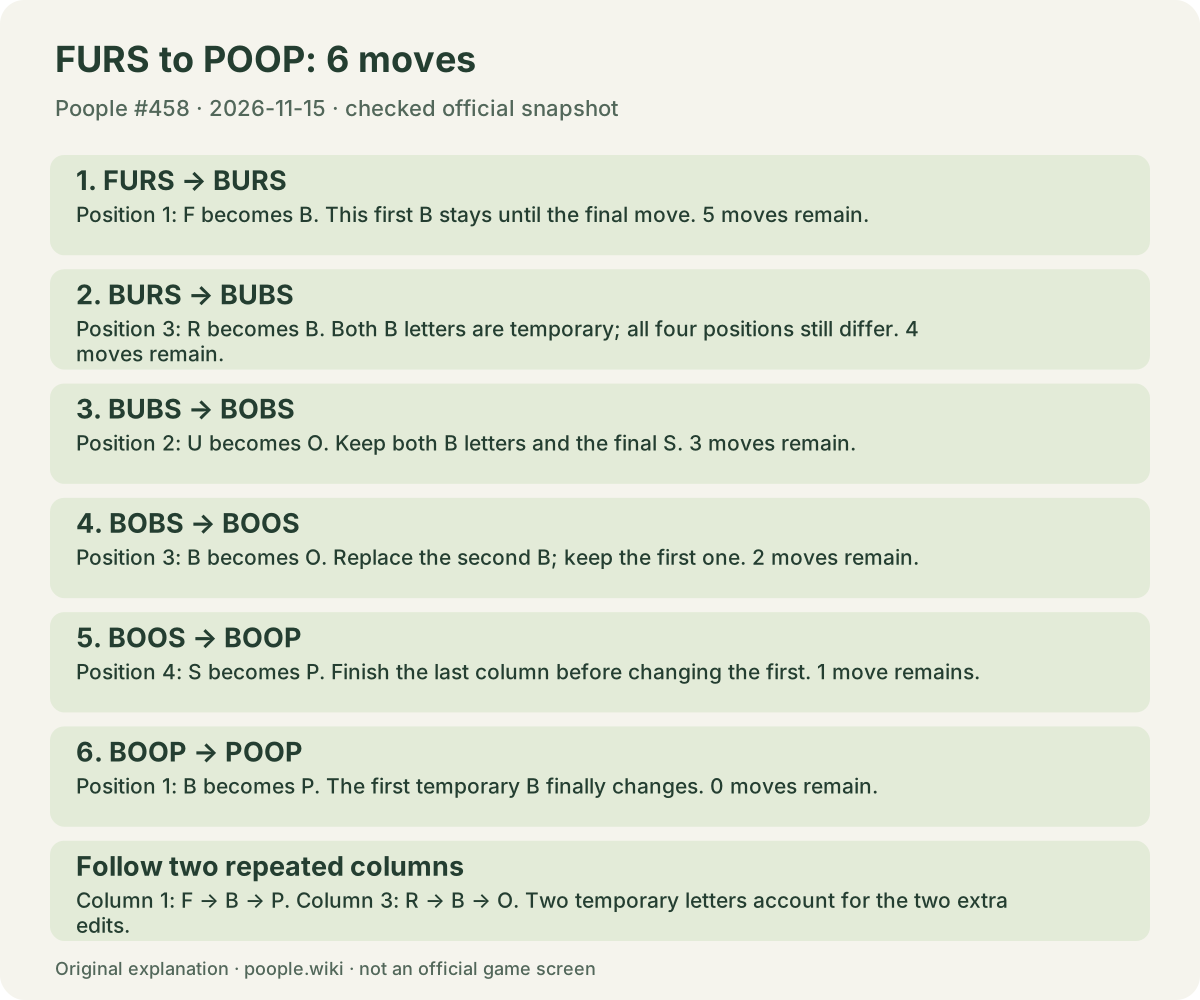
FURS → BURS → BUBS → BOBS → BOOS → BOOP → POOP
7 words. 6 changes. A shortest route in the checked official word list; equally short alternatives may exist.
FURS → BURS— position 1, F to B. Replace F with B at the left edge and preserve URS. This first B stays in position one until the final move.BURS → BUBS— position 3, R to B. Keep the opening BU and final S. Replace only R, creating a second B in position three while the first B remains fixed.BUBS → BOBS— position 2, U to O. Change U to O between the two B letters. This is the first target letter gained; both B letters and the final S stay unchanged.BOBS → BOOS— position 3, B to O. Replace the third-position B with O. The middle now reads OO, while the opening B is still needed for the displayed continuation.BOOS → BOOP— position 4, S to P. Change the final S to P and keep BOO intact. The right-hand P arrives before the left-hand P in this route.BOOP → POOP— position 1, B to P. Finish by replacing the first B with P. The OOP ending stays fixed, and the temporary letter introduced on turn one is finally removed.
Why this route works
The Poople answer for November 15, 2026, puzzle #458, is FURS → BURS → BUBS → BOBS → BOOS → BOOP → POOP. This six-move solution first introduces two temporary B letters. Neither opening move gains a target letter, but the second creates a position from which four direct replacements finish the puzzle. The useful pattern is not simply “put in a B”: the two B letters occupy different columns and disappear at different times. Follow their separate jobs, then check the two O changes and the final pair of P changes without combining any turns.
Track the two B letters separately
Read the opening as two decisions about two columns. FURS becomes BURS by changing position one, then BURS becomes BUBS by changing position three. The first B is not moved across the word to make the second. It remains at the left edge, and a separate replacement creates the other B. The fixed second letter U and final S help you check this distinction.
At BUBS, both B letters are temporary, but they have different lifetimes. The third-position B lasts through BOBS before becoming O. The first-position B survives BOBS, BOOS and BOOP, and becomes P only at the finish. Marking these columns separately on the diagram makes the later changes easier to follow than treating every B as the same piece.
All four positions in FURS, BURS and BUBS differ from POOP. Nevertheless, their verified distances are six, five and four moves respectively. Each opening move reduces the distance even though the visible target-match count stays at zero. This is a concrete example of why an unchanged match count cannot, by itself, tell you that a legal move has made no progress.
Build the middle OO one position at a time
The next pair, BUBS → BOBS → BOOS, replaces the middle letters in left-to-right order. First U becomes O in position two. Then the B in position three becomes O. The outer B and S remain untouched during both turns. After these changes, BOOS has the correct middle pair but still needs different letters at its two ends.
BUBS cannot become BOOS in a single turn. That would replace both U and the third-position B at once. BOBS is the intermediate row that separates those operations. A useful reading check is to cover the first and last columns and compare only UB, OB and OO. Each neighboring pair changes one character; the first and last pairs change two.
There is a similar trap one row earlier: BURS and BOBS share their first and last letters, but U would have to become O while R became B. The shared outline is not enough to make them neighbors. Keep BUBS between those rows when following this particular solution. Familiarity with a whole word should not replace a column-by-column comparison.
Finish at the right edge before returning to the left
BOOS is two steps from POOP in the checked word graph. Its middle OO already matches the target. The displayed finish changes the right edge first: BOOS becomes BOOP. Only after the final P is in place does the left-edge B become P. The two outer P letters therefore arrive on separate turns, with BOOP between the endpoints.
A direct BOOS → POOP entry would alter positions one and four together. Both complete words occur in the checked accepted set, but acceptance of the endpoints does not authorize a two-letter transition. BOOP supplies the missing separation. Compare BOOP with POOP and the difference is unambiguous: their last three letters agree, leaving only the first letter to replace.
This order also completes the story of the first move. The B introduced in FURS → BURS remains unchanged for four intervening transitions. It is not an extra letter that can be discarded for free; removing it costs the sixth move. When reading the last row, count that final B-to-P replacement even though the other three positions already look finished.
Locate both extra changes in the six-move budget
Following each column from start to finish accounts for all six replacements. Position one travels F → B → P, using two moves. Position two travels U → O once. Position three travels R → B → O, using another two moves. Position four travels S → P once. The total is two plus one plus two plus one: six.
The actual turn order is 1, 3, 2, 3, 4, 1. The two columns with repeated edits are separated in time, which can make the ladder seem shorter if you count only when a target letter appears. There are seven written rows, including the initial FURS. Count the six gaps between them, rather than assigning a move to the starting row.
Four starting mismatches establish a lower bound of four moves. They do not prove a four-move solution exists. Here, the current official par is six, and an independent breadth-first search of the accepted snapshot also finds six as the minimum. The column histories explain this route’s cost; the search evidence is what rules out shorter routes in that particular word set.
Join the continuation without losing your earlier move count
BUBS provides a useful checkpoint. It has four target mismatches and a checked four-move finish: BOBS, BOOS, BOOP, POOP. Every remaining turn fixes one previously unfinished column and leaves the others alone. No finish from BUBS can require fewer than four one-letter changes, so this continuation reaches the simple mismatch lower bound exactly.
The complete attempt still includes whatever you spent reaching that checkpoint. For example, reaching BUBS after four moves and then using its four-move finish gives eight moves overall. It does not produce the six-move total shown here. Likewise, reaching BOOS after five moves leaves a two-move continuation and an eventual total of seven. These are counting examples, not claims about observed player attempts.
Use the current row, rather than a vaguely remembered section of the answer, when deciding which continuation applies. The source gives remaining distances of five at BURS, four at BUBS, three at BOBS, two at BOOS and one at BOOP. A route that reaches one of these exact words can use the corresponding suffix, but skipped rows or different letters need their own legal-transition check.
Check acceptance without inventing a dictionary explanation
BURS, BUBS and BOOP may prompt a vocabulary question, but this page does not infer their acceptance from a guessed definition. Each complete entry is present in the official accepted-word snapshot examined at 09:15:41 UTC on November 15. The route checks also compare adjacent spellings independently. Word membership and a valid one-letter edge are separate requirements; both are needed for every turn.
The evidence identifies game day November 15, puzzle #458 and the starting word FURS, with a window beginning at 08:00 UTC. It supports one shortest route among 2,398 accepted entries, not a unique solution or a difficulty rating. Our separate solver uses an independent vocabulary. The diagram and video below explain this verified sequence; they do not claim that we replayed it through the official game interface.
Watch the route explained
Remaining moves on this checked route
| Word | Moves to POOP |
|---|---|
| FURS | 6 |
| BURS | 5 |
| BUBS | 4 |
| BOBS | 3 |
| BOOS | 2 |
| BOOP | 1 |
| POOP | 0 |
Each suffix of a shortest route must also be shortest: a shorter suffix would give a shorter complete route. These values describe remaining changes, not the moves already used on your board.
What this Poople answer teaches
Repeated letters can have separate roles. Track their positions and lifetimes instead of treating them as interchangeable pieces.
A shortest remaining finish does not erase moves already used. Add the complete approach to the continuation when comparing a final total.
How this Poople answer was verified
Source identity and route checks
We checked the public official game implementation on . Its accepted-word distance table and an independent breadth-first search both give a minimum of 6 moves for FURS. This answer was checked against its source and algorithm; we did not replay it through the official game interface.
The source snapshot identifies this as puzzle #458. A later change to the original dictionary could alter which words are accepted. The independent solver uses a different word list, so its shortest distance can differ.
- Official Poople game — checked 2026-11-15.
- Official public game implementation — checked 2026-11-15.
Corrections and verification limits
Corrections are recorded here when a published result changes. No corrections have been recorded for this revision. See our editorial policy or report a rejected step. The verification timestamp is the source observation, not a claim that a human played through the original interface.
More Poople help and recorded puzzles
For a smaller nudge use today's Poople hints. For another starting word use the Poople solver with its independent-dictionary notice, or review how to count one-letter moves.
Browse all verified past Poople answers by game date, starting word or puzzle number.
- November 14, 2026 (#457): TIRE — adjacent published record, not necessarily the previous or next game day.